
Climate Policy News in Europe: What Changed in November 2026

European climate policy moved on several fronts in November 2026: the EU’s 2040 target is now law, the UK and EU have agreed to link their carbon markets, methane and waste reporting deadlines have slipped, and COP31 ended without an overall deal. This briefing sets out each development, the date it happened and what it means for businesses, councils and public bodies that have to plan around it. We follow these stories daily at Exereco, and we pair them with ESG reporting, advisory and training so that the news turns into action.

Key Takeaways
The EU’s legally binding 2040 target is a 90% net greenhouse gas reduction, with up to 5% allowed from high-quality international credits. The amendment entered into force in April 2026.
The UK and EU concluded talks on 20 November 2026 to link their emissions trading schemes from 1 January 2028, subject to ratification on both sides.
Two compliance deadlines have moved: Methane Regulation import reporting is provisionally delayed by two years, and mandatory digital documents for green-listed waste shipments now start on 1 September 2027.
COP31 closed on 22 November without an overarching cover decision, but the EU is pressing on with its own rules and preparing for COP32 in Addis Ababa.
The 2040 target is law, and emissions are falling
The biggest structural change is the 2040 goal. In December 2025 the European Parliament and Council reached provisional agreement on a 90% net reduction in greenhouse gases by 2040. The amendment to the European Climate Law, Regulation (EU) 2026/667, entered into force in April 2026. “Net” means emissions minus the carbon removed by forests, soils and technology, so the gross cut can be smaller than the headline figure.
The design includes flexibilities. Analysts at the German Institute for International and Security Affairs note that from 2036, Article 6 credits from third-country projects can count towards the target up to 5% of 1990 net emissions, and domestic carbon removal will no longer be capped. They argue that detailed Commission proposals now matter for the target’s credibility. For planners, the practical point is that the rules implementing 2040 are still being drafted, so sector-level obligations will keep changing through 2027.
On the data, the European Environment Agency’s Trends and Projections report, published on 9 November 2026, found that EU emissions fell 1.6% in 2025 on a preliminary basis. Net emissions stand 39% below 1990 levels. With planned policies included, the EU is projected to reach a 54% net cut by 2030, just short of its binding 55% target.
The same report shows where the work remains. Emissions rose year on year in domestic transport (0.3%) and buildings (0.8%), while industry cut 15 MtCO2e. Renewables supplied 12% of gross final energy consumption in transport and 27% in buildings, against 50% of energy production in the power sector.
The Commission’s 2026 progress report adds that wind and solar capacity reached 611 GW in 2025 and battery-electric car registrations reached 1.9 million, about one in six new EU cars. Power is moving fastest. Transport and heating are where policy is now concentrated.
For the wider legal background, our EU Green Deal summary explains the laws these updates amend.
Carbon markets: ETS, ETS2 and the UK-EU link
The EU ETS in 2025
The EU Emissions Trading System (ETS) puts a price on emissions from power, industry and aviation. The Commission’s report on the carbon market says it covered more than 12,500 entities in 30 countries plus Northern Ireland, with 1,163 million tonnes of CO2e, about 37% of EU greenhouse gas emissions. Revenues rose 11% to €43.2 billion, €3.7 billion went to the Social Climate Fund for the first time, and compliance reached 99.5%.
The July 2026 reform proposals set the direction for the 2030s. According to the Commission’s ETS page, the annual cap would fall by 3.7% a year from 2031 to 2035 and 1.7% a year from 2036 to 2040. It also describes a €100 billion Industrial Decarbonisation Bank and a requirement for member states to spend 50% of national ETS revenues on decarbonising ETS sectors. Negotiations could conclude as early as 2027.
ETS2 under pressure
ETS2 is the separate system that will price road transport and heating fuels. It starts in January 2028 after a one-year delay. On 23 November 2026, Euronews reported that climate ministers from Denmark, Finland, Germany, Luxembourg, the Netherlands, Portugal, Spain and Sweden wrote to Commissioner Hoekstra warning against further delay, while the Visegrad Group, Italy and Greece press to soften or delay it. If you supply fuels or run a large vehicle fleet, treat 2028 as the planning date but watch the Council.
The UK-EU link
This is the story most relevant to British readers. On 20 November 2026, leaders announced the conclusion of negotiations to link the two schemes, applying from 1 January 2028 once both sides ratify. The UK will extend its ETS to aviation and maritime, adding over 10 million tonnes of CO2 to the system.
The UK government’s explainer sets out what changes in practice:
From 1 January 2028, allowances issued in the UK or EU can be used for compliance in either scheme, including for emissions from the 2027 scheme year.
Both sides provide for mutual exemptions from the EU Carbon Border Adjustment Mechanism (CBAM) once the link is fully operational, subject to EU legislative procedures.
The UK ETS Authority says the agreement could add up to £3.8 billion a year to the UK economy by 2040 and create conditions for a CBAM exemption on £6.5 billion of UK exports.
Aircraft operators flying UK to EEA routes get a one-stop shop instead of two separate schemes.
CBAM is the EU’s carbon charge on certain imports. It is also spreading: an EEA Joint Committee decision that entered into force on 18 November 2026 means the same CBAM rules apply to imports into Iceland and Norway from 1 January 2027. On 16 November the Commission also published an implementing regulation on deducting carbon prices paid in non-EU countries. Exporters to Europe should check how any carbon price they already pay abroad is treated.
Methane Regulation: a two-year breathing space
The EU Methane Regulation, in force since August 2024, requires operators in oil, gas and coal, and importers of those fuels, to measure, report and verify methane emissions. On 14 October 2026 the Commission proposed a one-year postponement of the import-related obligations, citing the Middle East supply shock and volatile energy prices. Parliament’s position was a three-year delay.
The compromise came on 19 November 2026. The Council announced a provisional agreement under which:
Monitoring, reporting and verification obligations for importers of natural gas, crude oil and coal apply from 1 January 2029 instead of 1 January 2027.
Methane-intensity reporting for importers and EU producers applies from 5 August 2030 instead of 5 August 2028.
The Commission reviews implementation by 1 January 2028.
The details are in the Council’s press release. A law firm’s analysis notes that many other obligations remain in force and that the formal amendment is likely to be adopted before the end of 2026. It also points out that importers still need reliable emissions data from third-country producers and independent verification. A later deadline is a reason to build that data chain steadily, not to leave it.
Waste rules: new dates and extended producer responsibility
Waste shipment reporting has a new timetable. On 25 November 2026, the Commission and member states agreed to extend the transition for green-listed waste shipment documents. Digital use stays voluntary until 1 September 2027, when it becomes mandatory, instead of 1 January 2027. The digital system, DIWASS, has been mandatory since 21 May for shipments needing prior consent, including hazardous waste and waste for disposal. Its module for green-listed waste became available on 15 November.
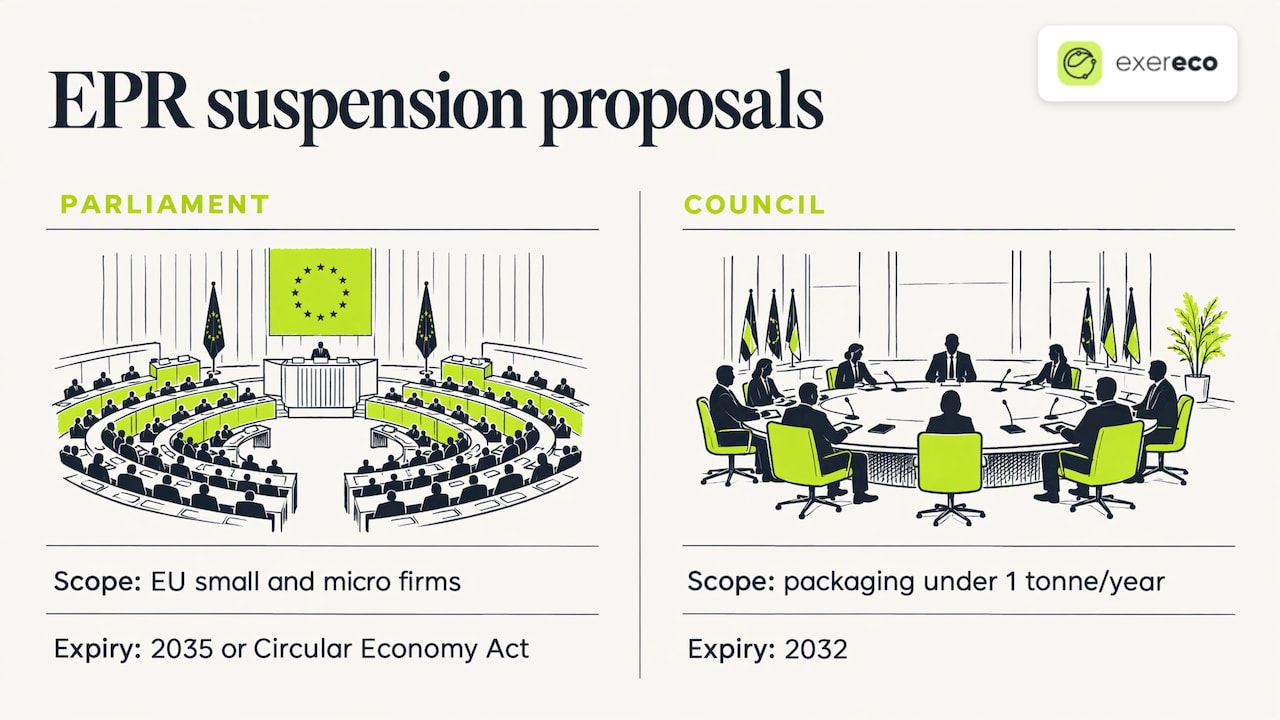
Extended producer responsibility (EPR) means producers pay for the end-of-life handling of what they put on the market. Parliament adopted its position on suspending the authorised-representative rules by 612 votes to 8, with 39 abstentions on 20 October 2026. It backs a targeted suspension only for EU-based small and micro enterprises until 2035 or a circular economy act, keeping requirements for third-country producers. The Council’s mandate is narrower, limited to packaging producers placing under one tonne a year in another member state, with a 2032 expiry. A Circular Economy Act proposal is expected on 2 December 2026.
For local communities and councils focused on waste reduction, the direction is steady: more digital traceability and clearer producer duties. Our guide to European waste regulations explains what the rules require.
COP31: no cover decision, but the work continues
COP31 in Antalya, Türkiye, ended on 22 November 2026 without an overarching cover decision, the first time since 2009. According to the European Parliament’s research service, a coalition of more than 130 parties including the EU rejected a draft with no language on transitioning away from fossil fuels, which an OPEC-led group had blocked. Parties still adopted binding decisions on the Just Transition Mechanism, the Belém Adaptation Indicators, adaptation-fund access to Paris Agreement carbon-trading proceeds and a plan for the second global stocktake.
The EU’s joint declaration said it could not endorse a cover decision that greenwashes fossil fuels, and that preparations for COP32 in Addis Ababa begin immediately. That matters for readers in Africa and Europe alike: the next conference is on African soil.
Two Australian climate law academics, writing in The Conversation, stress that the failed text was an add-on rather than a requirement, so the Paris Agreement and the COP process continue, and several countries are launching fossil-fuel phase-out roadmaps.
One practical outcome came from the side meetings. On 20 November the EU endorsed the Antalya Compact for Energy Efficient Buildings, a non-binding pledge, backed by 24 countries, to cut buildings’ energy intensity by at least 25% by 2035 against 2020. Given that building emissions rose in 2025, expect it to shape procurement and retrofit planning.
What to do with this news
Policy news only helps when it reaches a calendar. This table turns the November developments into planning points.
Development | Who is most affected | Planning point |
90% net target for 2040 | Every EU-facing sector | Expect implementing rules through 2027; set long-range targets against 2040 |
UK-EU ETS link from 1 January 2028 | UK and EU ETS participants, aviation, maritime | Review allowance strategy and 2027 scheme-year emissions |
CBAM extension and carbon price deductions | Importers and exporters of covered goods | Record carbon prices paid in non-EU countries |
Methane Regulation delay | Fuel importers, oil, gas and coal operators | Keep building supplier data and verification arrangements |
Waste documents mandatory from 1 September 2027 | Waste shippers, recyclers, local authorities | Prepare digital workflows for green-listed waste |
EPR suspension and Circular Economy Act | Producers, packaging and electrical goods firms | Watch the proposal expected on 2 December 2026 |
ETS2 from January 2028 | Fuel suppliers, fleet and heating operators | Treat as the planning date; follow the Council debate |
Climate rules rarely arrive alone. They share a compliance calendar with other duties, from data protection, such as CCTV GDPR rules for UK businesses, to waste and energy reporting. A single dated register of obligations, with an owner for each, stops deadline changes like the two this month from being missed.
For public bodies the same logic applies. Buildings and transport are where emissions are still rising, and where public estates and fleets sit. Cities tracking the buildings compact and ETS2 can plan retrofit and fleet budgets now. For a sense of how national targets get tested, see our report on how Ireland’s industry is set to miss its 2030 climate target.
From news to compliance with Exereco
Exereco combines sustainability news and analysis for Europe and Africa with ESG reporting software, advisory and compliance support, ESG training courses and community networking events. Organisations that need to track the deadlines above can bring the reading, the reporting and the expert support together in one place, rather than piecing them together from separate providers. Our SDG 13 Climate Action page shows how we support climate work, and our Europe sustainability news roundup keeps the wider picture in view. For what we cover in full, start at exereco.com.
FAQ
What is the EU’s 2040 climate target?
It is a legally binding 90% net greenhouse gas reduction by 2040, set in an amendment to the European Climate Law that entered into force in April 2026. Up to 5% can come from high-quality international credits. The EU’s existing 2030 target is a 55% net cut.
When does the UK-EU carbon market link start?
The agreement is due to apply from 1 January 2028, subject to ratification in the EU and UK. From then, allowances from either scheme can be used for compliance in both, including for 2027 emissions. The UK government’s explainer has the full terms.
Has the EU Methane Regulation been delayed?
Partly. A provisional agreement on 19 November 2026 postpones importer monitoring, reporting and verification to 1 January 2029, and methane-intensity reporting to 5 August 2030. Many other obligations stay in force, and the formal amendment still has to be adopted.
Did COP31 fail?
It ended on 22 November 2026 without an overarching cover decision, but it did adopt binding decisions on the Just Transition Mechanism, adaptation indicators and the second global stocktake. The Paris Agreement process continues, and COP32 will be held in Addis Ababa.
When do green-listed waste shipment documents have to be digital?
Digital use becomes mandatory on 1 September 2027, after the Commission and member states agreed an extension on 25 November 2026. Before that date it is voluntary. Shipments needing prior consent have been using DIWASS since 21 May.
Recommended


Comments